What actually holds a face up
Explore a facial region and the relevant anatomy ↗Five layers, stacked from the surface down. Aging acts on all of them, and a facelift can reach some of them. Knowing which is which is most of the decision.
Skin
The outermost layer. It thins with age and loses elastic recoil, so it creases more readily and springs back less. Skin quality and skin excess are different contributors to facial appearance. Skin quality responds to sun protection, retinoids, and resurfacing. A facelift can redrape and remove excess skin, but does not erase pigmentation or all surface lines.
Superficial fat
Beneath the skin, the fat is arranged in discrete compartments rather than a single sheet. The malar compartment over the cheekbone, the nasolabial compartment beside the nose, and the jowl compartment along the jaw each behave differently over time. Some lose volume. Some descend. The nasolabial fold is largely the boundary between a cheek compartment that has dropped and a lip compartment that has not.
The SMAS
The superficial musculoaponeurotic system is a continuous sheet of fibrous tissue and thin muscle that wraps the face and extends into the neck as the platysma. It is the structural layer that most facelift techniques work on, either by tightening it in place or by releasing and repositioning it. Its treatment is one part of a broader plan; longevity also depends on the operation, patient factors and continuing aging.
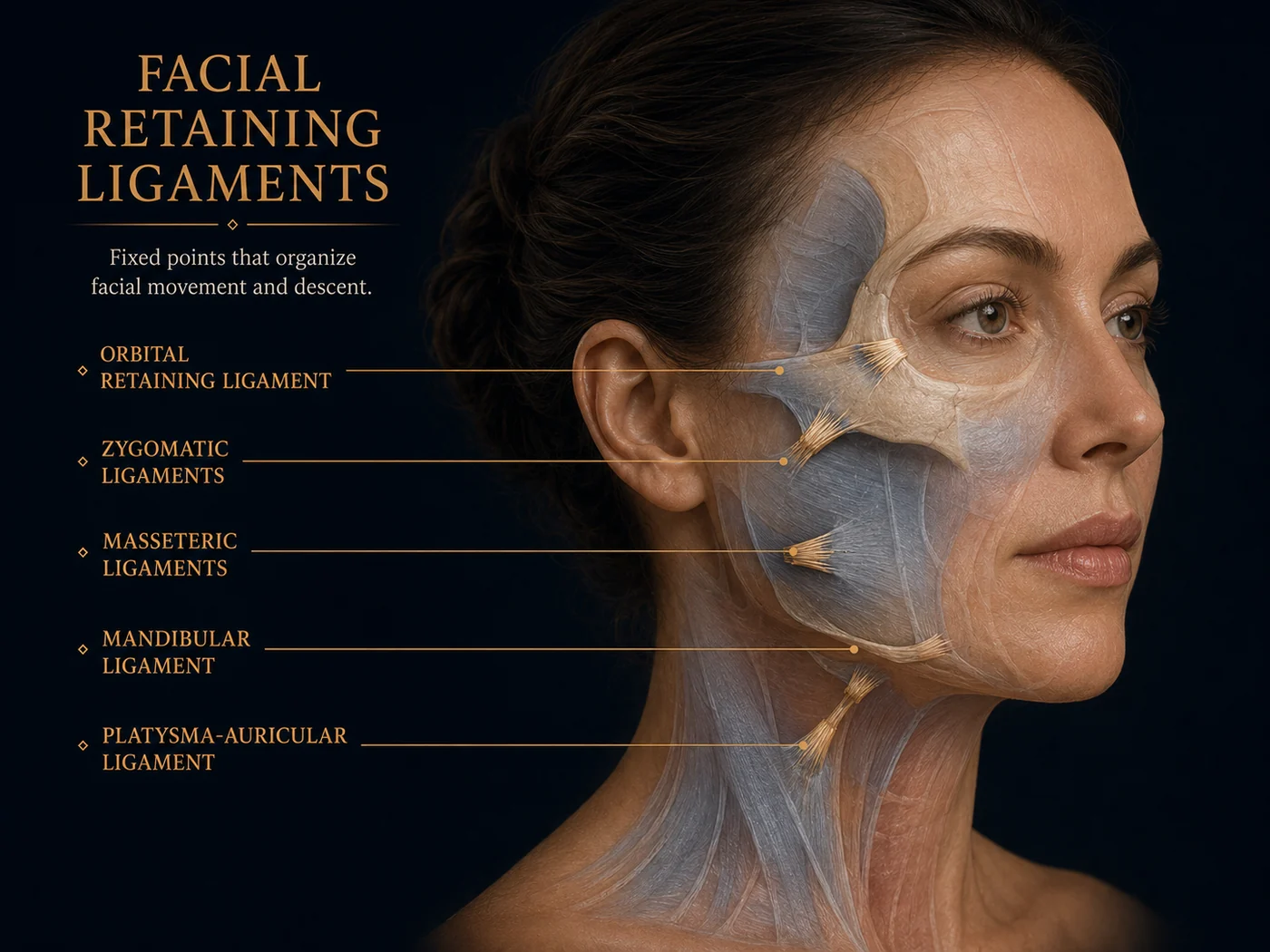
Retaining ligaments and the deep plane
A small set of ligaments tethers the soft tissue to the bone at fixed points: the zygomatic ligaments over the cheekbone, the masseteric ligaments along the jaw, the mandibular ligament at the chin. They are why a face ages in a particular pattern rather than sliding off uniformly. Deep plane techniques work beneath the SMAS in selected regions and release relevant retaining structures. The tissue relationships and location of facial nerve branches vary by region; this is not a single uniform space across the face.
Bone
The skeleton is the frame everything above it hangs on, and it changes too. The orbits widen, the midface recedes, and the jaw loses height at its angle. No lift addresses bone loss directly, which is one reason results vary between people who are otherwise similar, and one reason volume is sometimes added alongside a lift.
The short version. A facelift may address deeper support and excess skin. Skin redraping is an important part of many operations, while surface texture and volume require separate consideration.