How the face changes with time
Facial aging is not a single process. Skin, fat, connective support, muscle and SMAS, and bone change together, but not always at the same rate or in the same way. The four sections below are a practical framework for understanding those changes. The balance is different in every face.
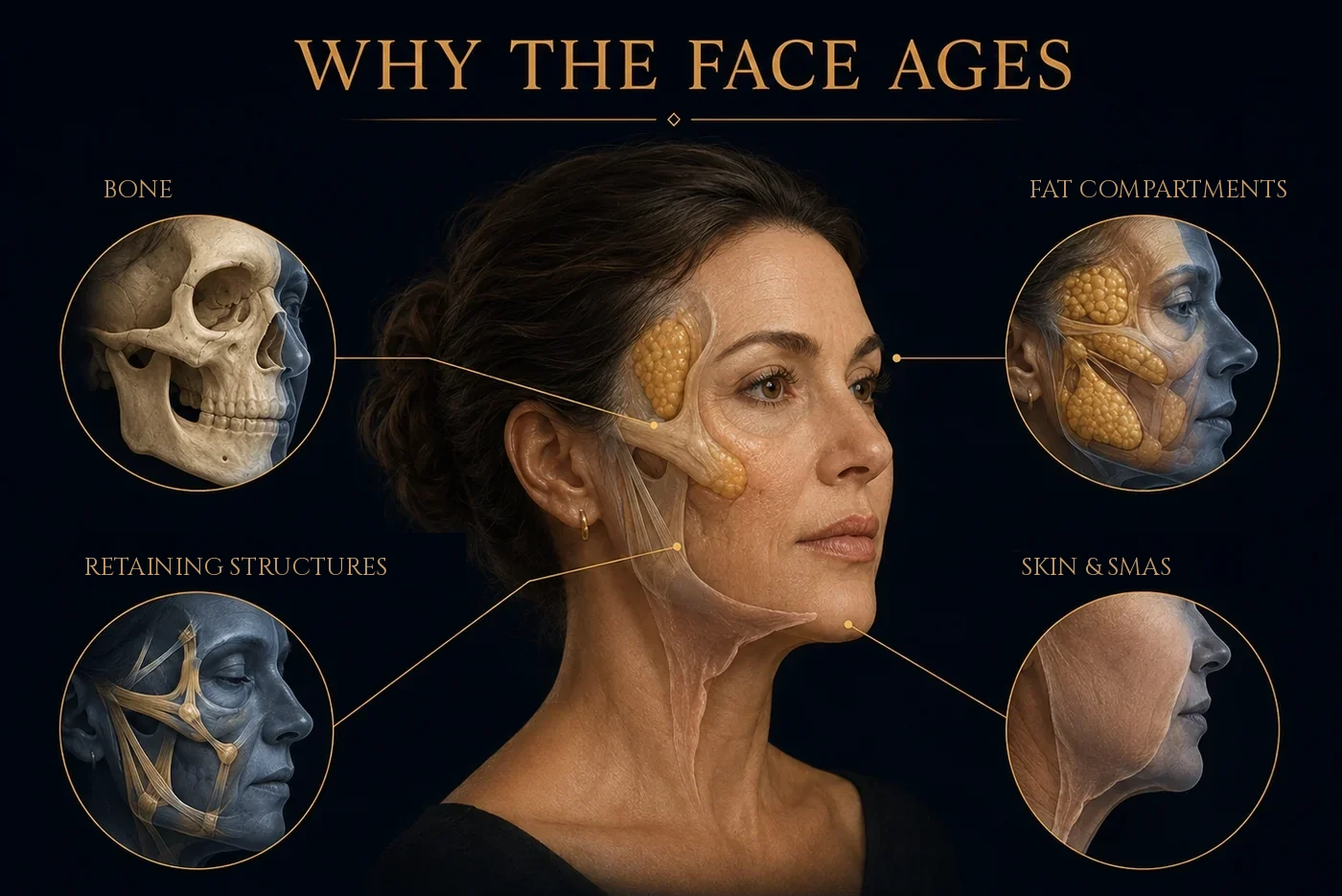
1. Fat changes position and volume
Facial fat is organized into distinct superficial and deep compartments, and they do not all age alike. Some lose volume, some retain or develop greater relative fullness, and several may shift downward.
In the midface, loss of deeper volume and redistribution of superficial fat can flatten the cheek, make the nasolabial fold more visible, and contribute to fullness in the lower face. These changes interact with skin laxity, skeletal remodeling, and the face’s fixed retaining structures. They are not simply one piece of tissue sliding from the cheek into the jowl.
2. Support relationships change
Retaining ligaments and fibrous septa connect the skin and superficial tissues to deeper fascia and bone. As surrounding tissues change, the face may descend or bulge around these relatively fixed points, making folds and boundaries more visible.
It is commonly said that facial ligaments simply stretch with age. Human evidence has not established this as a universal mechanism. Changes in fat, skin, SMAS, muscle, and bone are likely at least as important as changes within the ligaments themselves.
3. Skin changes
Skin undergoes both intrinsic aging and cumulative environmental damage, particularly from ultraviolet exposure. Collagen becomes less abundant and more fragmented, elastic tissue changes, and the skin becomes less resilient. Fine lines, uneven pigmentation, texture changes, and laxity may follow.
Skin quality and skin laxity are related but different. Sun protection, prescription retinoids when appropriate, and resurfacing treatments primarily address photodamage and texture. A facelift can redrape and remove excess skin, but it does not erase pigmentation, pores, or fine surface lines.
4. Bone remodels
The facial skeleton continues to remodel throughout adulthood. The orbital openings tend to enlarge, portions of the midface and maxilla may recede, and the mandible can lose height and length while its angle becomes more obtuse. The pattern and degree vary considerably among individuals.
A facelift does not restore facial bone. It can, however, improve the position of the overlying soft tissues. Strategic volume restoration or implants may compensate for reduced skeletal support in selected patients, but these treatments augment the contour rather than reverse bone aging.
What this means for treatment
| Primary change | What may help | Important limitation |
|---|---|---|
| Fat redistribution or volume loss | Surgical tissue repositioning, selective fat grafting or filler, and occasionally reduction of localized fullness | Filler may soften a fold but does not reposition descended tissue. Lifting does not automatically restore missing volume. |
| Soft-tissue descent | Appropriately selected SMAS-based surgery, including plication, imbrication, extended SMAS, or deep-plane techniques | No single technique is best for every face. Energy devices generally provide less correction than surgery for moderate or advanced descent. |
| Mild skin laxity | Selected radiofrequency, ultrasound, laser, or other energy-based treatments | Results are generally more modest and less predictable than surgery. |
| Excess or substantially lax skin | Surgical redraping and removal as part of a facelift | Surgery does not correct every surface wrinkle or pigment change. |
| Texture and photodamage | Sun protection, prescription retinoids when appropriate, resurfacing, and selected dermatologic treatments | These treatments do not reposition deeper facial tissues. |
| Reduced skeletal support | Strategic filler, fat grafting, or implants in selected patients | These treatments camouflage structural change. They do not regenerate facial bone. |
| Thread-based lifting | May provide temporary improvement in carefully selected patients | Long-term efficacy and durability remain insufficiently established. |
Most visible facial aging reflects a combination of these changes. A useful consultation identifies which layers contribute most, what can realistically be changed, and which tradeoffs are acceptable.
Selected evidence and study types
19 sources
Much of the facial aging literature is cross-sectional, cadaveric, animal-based, or drawn from relatively small imaging studies. The study type is named below so the strength of each claim can be judged.
Fat compartments and facial volume
- Gierloff M, et al. Aging changes of the midfacial fat compartments. Cadaveric and imaging study.
- Cenkeri HC, et al. Aging changes of the superficial fat compartments of the midface. Cross-sectional imaging study.
- Wen LH, et al. Analysis of age-related changes in midfacial fat compartments. Cross-sectional imaging study.
- Rohrich RJ, Pessa JE. The fat compartments of the face: anatomy and clinical implications for cosmetic surgery. Cadaveric anatomical study.
Retaining structures, folds, and jowls
- Brandt MG, et al. Biomechanical properties of the facial retaining ligaments. Small human cadaveric biomechanical study. Found no age-related difference in ligament dimensions or properties.
- Zhang YL, et al. Age-related changes of the zygomatic ligament: an experimental animal study. Animal study. Findings do not transfer directly to humans.
Skin aging and prevention
- Hughes MCB, et al. Sunscreen and prevention of skin aging: a randomized trial. Randomized controlled trial.
Facial skeletal remodeling
- Kahn DM, Shaw RB. Aging of the bony orbit: a three-dimensional computed tomographic study. Cross-sectional CT study.
- Shaw RB Jr, et al. Aging of the mandible and its aesthetic implications. Cross-sectional CT study.
Treatment limitations
- FDA. Dermal Fillers, Soft Tissue Fillers. Regulatory guidance.
- Stefura T, et al. Tissue fillers for the nasolabial fold area: a systematic review and meta-analysis. Systematic review and meta-analysis.
- Khoury S, et al. The deep plane versus SMAS facelift: a systematic review. Systematic review.