The techniques, compared
Compare two approaches side by side ↗Every facelift is a decision about which layer to work on and how much to release. The names describe that decision. None of them is right for everyone.
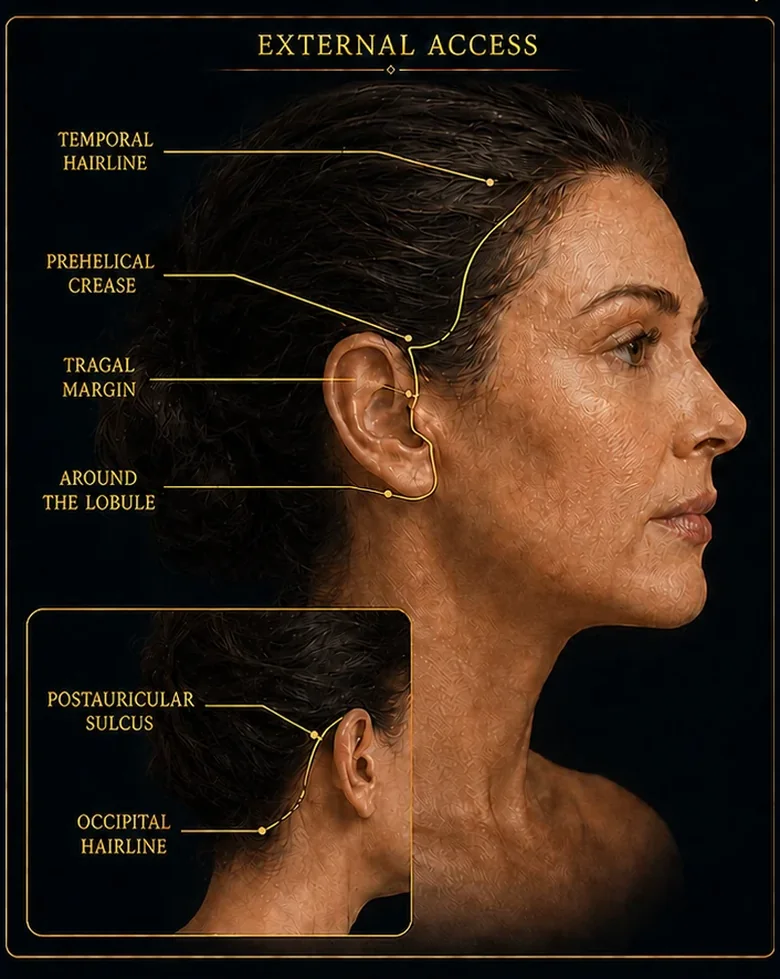

Skin-only lift
The skin is separated from the tissue beneath it, pulled, and the excess removed. It was the standard operation for most of the twentieth century. It addresses skin laxity and very little else, because the structure that has descended is left where it is. Results tend to relapse early, and tension on the skin closure is what produces the pulled look most people are afraid of. It is rarely a first choice now, though there are situations, usually revisions or very limited goals, where it has a place.
SMAS plication
The SMAS is folded on itself and sutured in a tightened position, without cutting into it. The skin is then redraped without tension. It is a reliable, relatively lower-risk operation that improves the jawline and jowl well in the right patient. It does less for the midface, because the ligaments that hold the cheek down are not released. Longevity is moderate.
SMASectomy
A strip of SMAS is removed along the line of the jowl and the edges are sutured together, which shortens the sheet and lifts what hangs from it. Similar indications and limits to plication, with a somewhat stronger and more durable effect on the lower face in many hands. Also does not release the retaining ligaments.
Deep plane and extended deep plane
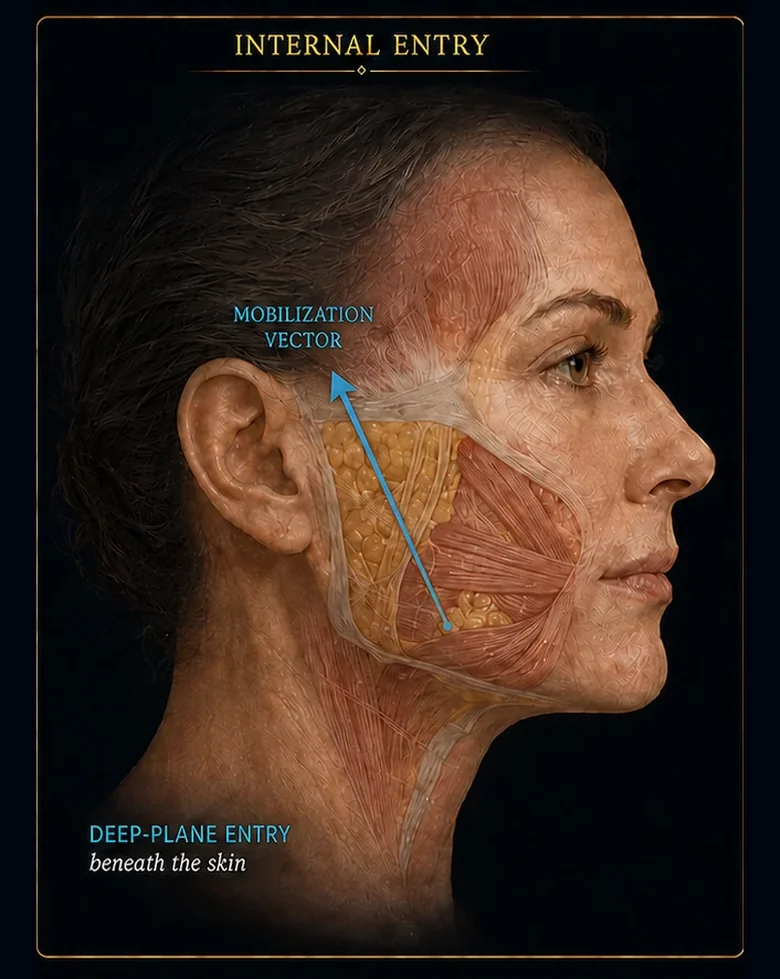
The dissection goes beneath the SMAS, into the gliding layer above the facial muscles, and the retaining ligaments of the cheek and jaw are deliberately released. The skin, fat and SMAS then move together as a single composite flap, repositioned along vectors selected for the individual anatomy. The extent of skin elevation and deeper release varies by technique. Preserving tissue connections and minimizing closure tension are surgical aims, but a technique name does not guarantee a natural appearance or superior longevity. The trade is a longer, more technically demanding operation with the facial nerve branches closer to the dissection, so surgeon experience matters more here than with any other approach. The extended variant carries the release further into the neck and around the mouth.
Neck: platysmaplasty
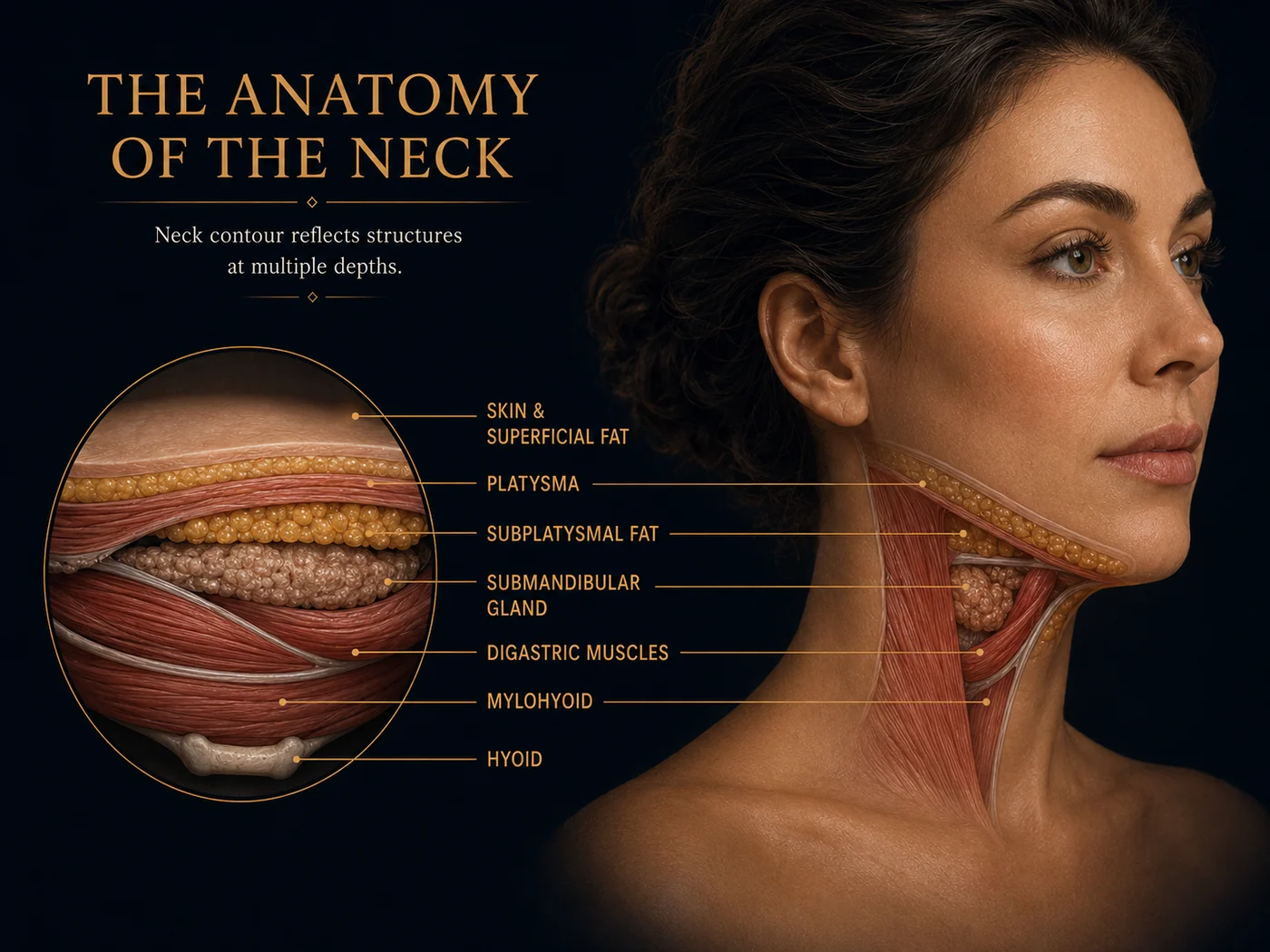
Most facelifts include work on the neck, because the SMAS continues into it as the platysma. The muscle edges can be sutured together in the midline, divided low, or released and lifted with the deep plane flap. Which of these is appropriate depends on what the neck looks like at rest and when the patient grimaces, which is why the consultation includes that test.
Deep neck lift, and the submandibular glands
Some necks are not a skin or platysma problem at all. The heaviness sits beneath the platysma: subplatysmal fat, bulky anterior bellies of the digastric muscles, or submandibular glands that are large or have settled below the jawline. Tightening the platysma over that volume does not remove it, and can make the fullness more obvious by pulling a firm sheet across it. A deep neck lift addresses the layer directly. Through a short incision under the chin, the platysma is opened in the midline, the subplatysmal fat is reduced, the digastric muscles are trimmed where they are contributing, and the platysma is then closed over a flatter floor.
Submandibular gland treatment requires a specific anatomical indication and a discussion of additional risks. Where the gland is what is filling the space below the jaw, a partial resection of its superficial lobe reduces that bulk. It is a controlled, limited removal, not a gland excision, and the effect on salivary function depends on the patient and extent of treatment and should be discussed, particularly when dry mouth is already present. The specific risks are bleeding into the neck, a temporary collection of saliva under the skin, and weakness of the marginal mandibular nerve branch that runs nearby, all uncommon in experienced hands and all worth asking about.
The deep neck can be done as part of a facelift or on its own. As an isolated procedure it suits a younger patient whose face has not yet descended but whose neck has always been full, or someone whose earlier neck surgery addressed only the skin and platysma and left the deeper volume in place. It is also the honest answer for the person who has been told they need a full facelift when what they actually have is a heavy neck.
Endoscopic deep plane lift
The deep plane can also be entered through small hidden incisions, in the temporal hairline and sometimes inside the mouth, with a camera to guide the dissection. The work beneath the surface is the same: the retaining ligaments of the cheek are released and the composite flap of skin, fat and SMAS is repositioned upward and outward. What is different is that no skin is removed, so the result depends entirely on the skin's own ability to contract over the lifted tissue.
In the right patient that is enough for a complete facelift. Someone in their late thirties to early fifties with good skin quality, early descent of the midface and early jowling, and little true skin excess can have the cheek and the jawline addressed together through these incisions, without the incision around the ear. The trade is selection. Where there is meaningful skin excess, established neck laxity, or heavy jowls, the endoscopic route leaves loose skin behind and the standard deep plane approach with skin redraping is the better operation. A surgeon offering this should be able to say plainly which of the two you are, and why.
The older marketing labels attached to small-incision surgery (mini, lunchtime, weekend) describe the incision, not the operation and not the recovery, and are worth ignoring.
| Technique | Reaches | Does poorly | Durability |
|---|---|---|---|
| Skin-only | Skin laxity | Everything structural; risks a pulled look | Short |
| SMAS plication | Jowl, jawline | Midface, deep neck | Moderate |
| SMASectomy | Jowl, jawline | Midface | Moderate to good |
| Deep plane | Midface, jowl, jawline, neck | Skin texture, bone loss; highest technical demand | Variable; superiority in longevity is not established for every patient |
| Endoscopic deep plane | Midface, jowl, jawline, with hidden incisions | Skin excess, neck laxity; depends on skin recoil | Depends on selection and the specific operation |
| Deep neck, with or without gland reduction | Fullness beneath the platysma, the submental angle | Skin excess, jowls, the face itself | Long |
A surgeon who performs one technique on everyone has a hammer. Ask which technique they would choose for you and why, and ask what they would do differently for someone ten years younger or older.
Sources and context
Khoury et al.: systematic review and meta-analysis of deep plane and SMAS facelifts (2025). The study assesses satisfaction and complications across included series; it does not establish a universal longevity ranking.